
Quick Answer
First choose the attachment option, and then choose the sound. An IPX5 or higher rating with a weight of less than 40g that passes a 40-minute test run without sliding will be better than any top of the range model that slips.
• IPX5 vs IPX4: IPX5 will take both sweat and rain, while IPX4 cannot handle summer training.
• Open Designs: Open ear or bone conduction models will weigh 26 to 36g and will allow for traffic to be heard.
• Lifespan: You can expect 18 to 24 months of use before sweat finally destroys a sealed pair of in ear gear.
What Actually Makes a Headphone a Running Headphone?
There is a distinct reason why this is called a running headphone, plus there are three design decisions the marketing will hardly ever make note of. These include an ingress ranking that has been examined to IEC 60529, a mechanical anchor that is robust to footstrike vibration rather than friction alone, and a housing that drains sweat instead of trapping it next to the driver.
The trick here is that sweat is not water. Its concentration is about 0.9% saline, and salt water is far more corrosive to copper contacts and adhesive bonding seams than rainwater. The lesson is that a couple of headphones can withstand six months of Seattle drizzle but die in one week of August interval training.
Warning: An IPX rating is determined on a brand-new unit. These all break down over time as gaskets degrade, and virtually every manufacturer will not cover sweat damage. Please read that clause prior to purchase.
Four Ways They Stay Put on a Wet Head
A headphone that moves every 200 meters gets adjusted rather than worn, and dropping a bud into a storm drain happens precisely because of the attachment method.
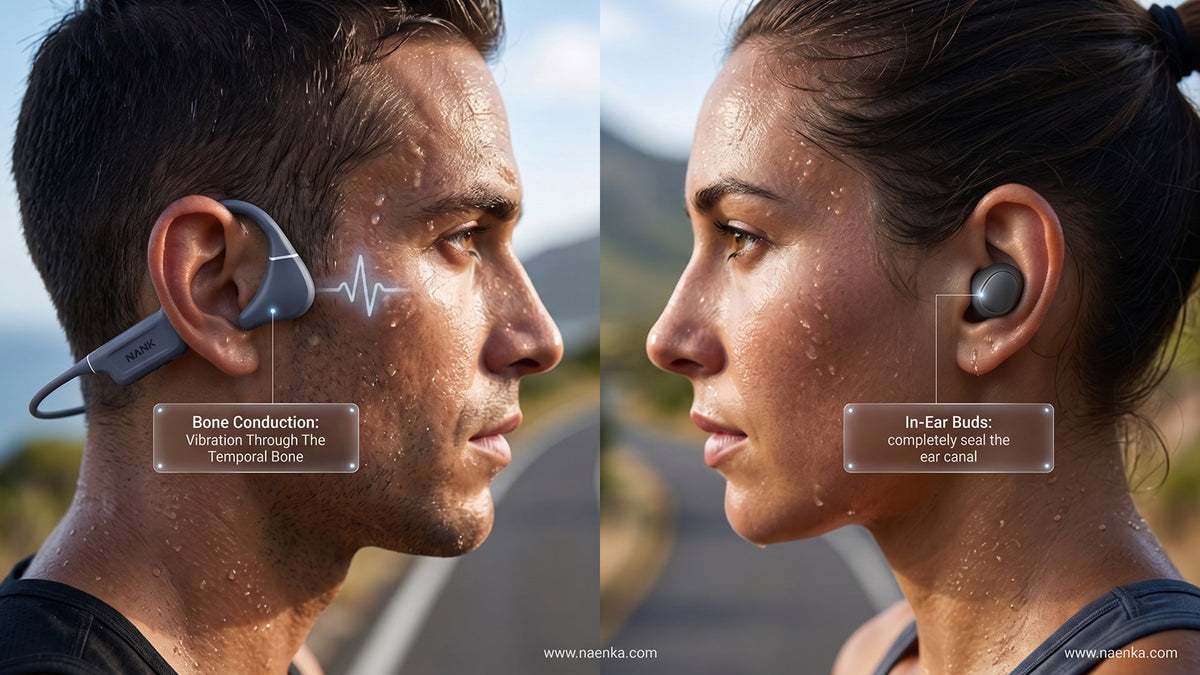
1. In-Ear Running Headphones: These utilize locking tips, a wingtip, or a hook. They provide the greatest isolation and the least sweat survival.
2. Earbuds Running Headphones: True wireless headphones that come with a charging case, weighing four to seven grams per side.
3. Open-Ear Running Headphones: These feature clips or hooks that rest outside of the ear canal with the ear completely open.
4. Running Bone Conduction Headphones: Transducers are placed on the cheekbone to conduct sound through the skull.
| Fit Type | Weight | Slip Risk | Honest Weakness |
| Sealed in-ear (wingtip) | 12 to 18g | Low | Driver end of life 18 to 24 months |
| True wireless buds | nine to 14g | Medium | One bud lost per 30 months |
| Open-ear clip | 11 to 16g | Low | Bass thins out markedly below 100Hz |
| Bone conduction band | 26 to 36g | Very low | Tickle sensation above 70% volume |
How To Choose The Best Running Headphones?
When it comes to running shoes, every runner desires the top option. Choosing audio gear follows the exact same logic. You must prioritize the short circuit risk, means of attachment, weight, and then sound.
Heavy sweaters will require an IPX5 minimum and a mechanical anchor, while treadmill users do not need to bother with either.
1. Start With Sweat, Not Sound Signature
The simplest thing to correct is the quality of sound, but it is the most difficult thing to test in a shop. Sealing is not easy to gauge either.
• Rating Floor: Testing for the weather requires an IPX5 rating. For indoor machines, an IPX4 is acceptable.
• Salt Exposure: Heavy sweaters must treat IPX5 as a strict necessity, not just a goal.
• Port Design: Recessed charging contacts will have less corrosion than flush contacts.
2. Match the Anchor to Your Ear Shape
Ears can be very different, and no two are alike. Through our watching, we have seen runners with shallow concha bowls fail with everything wingtip on the wall, go off track, and end up perfectly okay with a hook.
• Wing Tip: Hangs on the antihelix of the opposite ear. It is secure, but pressure builds at 90 minutes.
• Ear Hook: Fits over the top of the ear. This secures the most option and fights sunglasses.
• Clip-On: Bites at the edge skirt. It is comfortable and mildly visible.
3. Weigh Battery Against Your Longest Run
Play time is measured at 50% volume under manufacturer conditions in a laboratory. When outdoors, you can calculate that you will get 20 to 30% less than what the box boasts due to wind noise pushing you to turn the volume up. Most running Bluetooth headphones are capable of eight to 12 real hours, which should make running a marathon a cinch.
4. Test the Controls With Cold, Wet Fingers
• Physical Buttons: Operates smoothly during rainy weather and through gloves. They are somewhat more difficult to press in middle stride.
• Touch Panels: The touch panels detect raindrops down as taps. We have received returns that were purely due to rain during February with the tracks skipped on their own. When wet, they are unreliable. When dry, they are faster.
5. Read the Warranty Clause About Moisture
Industry standards for coverage range from 12 to 24 months, and the sweat exclusion is almost an industry standard. Specifically inquire if corrosion is included, and be absolutely sure that is in writing.
6. Run in Them for 40 Minutes Before You Commit
A ten-minute time is not enough to tell you anything. Hot spots, pressure points, and slippage occur specifically within the 25 to 40 minutes time frame. Most of the reviews running headphones get are conducted twice by testers in dried up surroundings and strictly inside. You do not have their ears!
Pro Tip: Run a test on a hot day. Cold ears are more crisp and stickier, which means a fit looks better in July than it would otherwise.
Learn About Workout Audio Gear!
Headphones are one part of a chain, and most times it is the other part that is acting as a bum. The requirement depends on what is feeding them, what you are training for, and where it is getting held on your phone.
• Mobile Phone Running Headphones: A phone in an armband provides an extra antenna length of 15 to 20cm. A sensor belt around the waist is more effective for carrying signals.
• MP3 Players Running Headphones: Always the most dependable pair, as there is not any mobile radio disturbing the connection.
• Music Running Headphones: Headphones that play the music at cadence matched tempos of 170 to 180 BPM are the only training tool we would really fight for.
The sound quality of running headphones is determined by the positioning of the antenna in relation to the skull, so those left side dropouts are extremely common when using the phone in a right pocket. All wireless headphones in outdoor use for all year round have a drop in battery life by the point of the 18th month, losing about 15 to 20%. You need to plan for it.
Should You Hear the Road, or Block It?
You should listen to the road in almost all outdoor instances. Sealed isolation cuts away the approaching vehicle cue you rely on using your peripheral hearing, and it is not safe on any road, trail, or shared path where something is moving faster than you are.
When deciding between running with headphones vs earbuds, the discussion is moot. It is strictly about whether or not the canal is clogged.
Two questions you should ask yourself: what amount of your weekly miles are spent in traffic, and do you work out by yourself?
What Should Good Running Headphones Cost?
The value really begins about $45 and then starts leveling off around $130. It is because of the drivers, the microphones, and the app support, and not an increase in sweat resistance or an increase in security.
| Price Band | What You Actually Get | IPX Rating | Expected Lifespan |
| $20 to $45 | Basic fit, thin bass, five to seven hr battery | IPX4 typical | eight to 14 months |
| $45 to $90 | Solid anchoring, eight to 12 hr battery | IPX5 to IPX7 | 18 to 30 months |
| $90 to $160 | Improved mics, app EQ, quicker charging | IPX5 to IPX8 | 24 to 36 months |
| $160 to $300 | Top quality brand producers | Varies widely | 24 to 36 months |
If you were looking at running open ear headphones for use during the summer, a pair of $55 open ear options would beat a $300 sealed flagship any day. Timing heavily helps, because running headphones sale pricing comes in late November and reduced costs on sports styles are normally 25 to 40% off of the list price.
NANK Runner Pro2: Our Pick For The Best Running Headphones
The real waterproof running headphones are given an IPX7 or IPX8 rating and typically have no exposed charging pins, which leads to them charging magnetically. The NANK Runner Pro2 is exactly that pair. It is rated IP68, it charges magnetically, and it is built on a bone conduction open-ear design. Bone conduction headphones do not even have to face the sealing issue since they do not go into the canal, so there is nothing with which it will become corrosive from the inside.
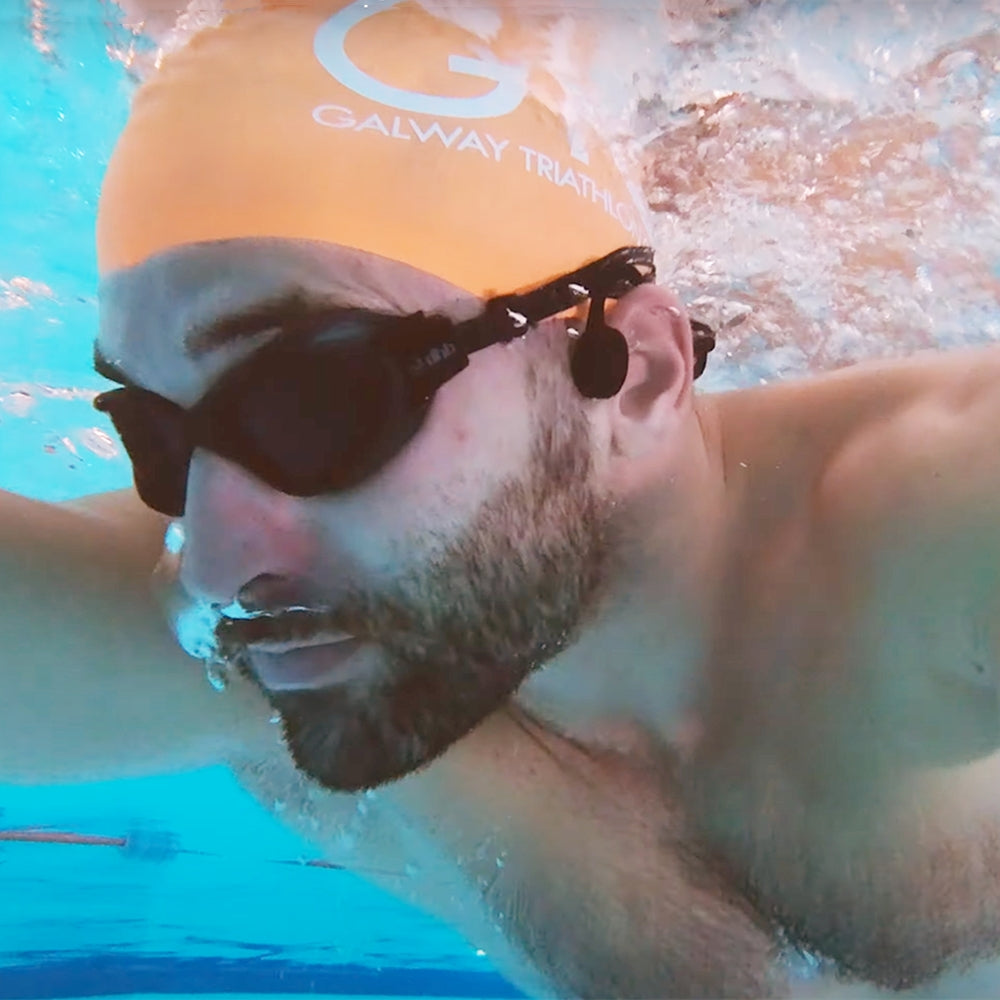
The Runner Pro2 swimming headphones adopt a professional waterproof design to meet the waterproof level requirements of athletes or swimmers, and can be submerged in water up to two meters deep for up to two hours. It is not really set in the ear. It rests on the cheekbones, which means the car horn and the dog, along with your podcast, all hit you at the same time. If you train on paths that are shared, that is the entire argument.
Key Features
• Bone Conduction Open-ear Design: Delivers audio through the cheekbone instead of air, so approaching cars and bicycles can be heard at normal volume settings.
• IP68 Waterproof Headphone: Rated well above the IPX5 floor, and compatible with your cycling glasses and helmet.
• 8-Hour Playback & Magnetic Charging: Recessed contacts will have less corrosion than flush contacts.
• Bluetooth 5.3 & 32G MP3 Player: MP3 mode is the most dependable pair, as there is not any mobile radio disturbing the connection.
• Leakage Reduction Sound & Shocking Sound: Exclusive OT leakage reduction 2.0 technology, less vibration, more comfortable while wearing. A 16mm dynamic vibrator speaker, so the sound quality is more open, the bass is thick and the mid-to-treble is fine.
• What is in the box: Bone Conduction Headphones x1, Charging Cable x1, Adjustable Size Plastic Banding Straps x1, User Manual x1.
✅ Pros: IP68 rating, magnetic charging with no exposed pins, very low slip risk, 32G onboard storage so one pair covers the road and the pool, compatible with glasses and helmets, and a one-year warranty.
❌ Cons: This model comes without the mic. There is clearly a dip below 100Hz, and bass heavy songs lose weight when sent via the skull transmission.
Best For: Heavy sweaters who require an IPX5 minimum rating alongside mechanical anchors, runners who train on shared paths, and anybody who wants one pair for road running and swimming.
Conclusion
The bottom line remains that most rating systems focus on sound, but within two years most sets become junk anyway. You must purchase equipment for survival first. Heavy sweaters require an IPX5 minimum rating alongside mechanical anchors. To secure appropriate running headphones, please visit NANK today and browse premium workout audio gear options right now.
Related articles: Best Open-Ear Headphones for Glasses Wearers and Smart Connectivity for Everyday Use.
Are The Open-Ear Designs Really Traffic Safe?
Yes, they are measurably safer than sealed buds. Properly, no element obstructs the path of the canal, so approaching cars and bicycles can be heard at normal volume settings. Hence, a number of race organizers allow these.
For Road Running And Swimming Can I Use One Pair?
Yes, if it is rated IP68 and it has an internal storage function. Only Bluetooth with a certified resistance to water penetrates the water, and it also has to be transferred to the wireless mode in case of landing. The NANK Runner Pro2 covers both with its 32G MP3 player.