

- 1. Introduction
- 2. Are Open Ear Headphones For Running Better?
- 3. How Open-Ear Audio Actually Reaches Your Head?
- 4. NANK Bone Conduction Vs. In-Ear Buds Comparison
- 5. Why Do Sealed Buds Keep Falling Out Mid-Run?
- 6. What Should You Check Before Buying A Pair?
- 7. What Fails First, And How To Make A Pair Last
- 8. NANK Runner 4 — Best Open Ear Headphones For Running
- 9. Conclusion
- 10. Frequently asked questions (FAQs)
Introduction
Everybody repeats that myth about audio devices. Wind erases half the podcast. Are open ear headphones for running better? Bone conduction changes everything for active runners. You hear traffic alongside ambient noise. Zero pressure means all day comfort.
Quick Answer: Yes, they are better if being used for road running. The open ear design takes the lead on situational awareness, the ability to sweat, and on all day comfort. Sealed buds are triumphant when it comes to bass and isolation. Build on bone conduction for water and sweat tolerance, and do not overthink driver specs.
• Bone conduction withstands IP68 immersion, whereas the majority of sealed sports earbuds stop at IPX4 water resistance.
• Zero canal pressure means no plugged ear ache after 90 minutes of long runs.
• At speeds greater than about 12 mph, the wind can literally thin bass on all open designs.
Are Open Ear Headphones For Running Better?
Yes, for the majority of road and trail runners, but not for all sessions. Open ear designs will eliminate canal pressure, last much longer in the sweats, and let you hear a car rolling up on you from the back. That situational awareness is more important than the bass they lose.
In marketing, the safety argument is exaggerated, but in practice, it is understated. Two of our customers in three years recount almost being hit by a silent electric vehicle at low speeds. They both converted to open ear subsequently. The comfort argument is the one people downplay prior to attempting it and will not surrender once they have tried it.
| Factor on a 10 mile road run | Open ear (Bone conduction) | Sealed in ear buds |
| Ambient audibility at 8:00/mile pace | Near normal hearing retained | 10 to 30% with ANC engaged |
| Typical ingress rating | IP67 to IP68 | IPX4 to IPX7 |
| Weight and where it sits | 26 to 35 g across two contact points | 9 to 12 g wedged in the canal |
| Output below 100 Hz | Rolls off, 8 to 12 dB deficit | Full extension |
| Comfort past 90 minutes | No canal fatigue reported | Pressure ache common |
That 8 to 12 dB figure is the entire argument represented as one number. If it is sub bass you are after, you already know the answer.
Pro Tip: Purchase one ingress rating higher than your worst weather, not your average weather conditions. It is always the pair of buds caught in the storm you never expected that dies.
How Open-Ear Audio Actually Reaches Your Head?

Two completely different technologies get categorized under the same name, and the difference matters enormously once you sweat on the items.
A bone conduction headphone is used to place a small transducer against your cheekbone, just in front of your ear. When vibrating, it stimulates the temporal bone, and the cochlea interprets the vibrations as sound. Your eardrum is out of the loop entirely. For runners, no door is closed, nothing is blocked, and nothing gets pushed.
An air conduction open ear design is a different beast. A small speaker is attached outside the ear and turned inward, firing sound across the canal opening without entering it. Sound quality is improved compared to bone conduction, especially in the midrange. However, leakage is worse, so you must pick your poison. Read the ingress rating and the weight instead of the title.
NANK Bone Conduction Vs. In-Ear Buds Comparison
Anyone hunting the best bone conduction headphones for running should weigh these dimensions in this exact order.
1. Fit Security: What Stays On At Mile 12
Under constant, light tension, the bone conduction frame follows around the back of the head. Nothing was inserted, so there is nothing to eject.
Titanium Band Memory: A support frame that will bend right back into its original shape after an incredible 500 flexes without breaking or loosening.
Contact Pressure: Roughly 1.5 to 2.5 N per pad is comfortable. If it is too tight, it will cause temple ache after two hours.
Glasses Compatibility: Bone conduction arms will sit below temple arms, so both fit perfectly. Clip ons often do not.
We have never had one come back due to a fit failure with any bone conduction unit. With silicone tips, we see them weekly.
2. Sweat And Water: Where Sealed Buds Quit
Perspiration is salty, a bit acidic, and gets everywhere. This is by far the largest cause of running headphone deaths that we see.
Ingress Standard: IPX4 means only splash resistant and nothing more.
Full Seal Advantage: With waterproof bone conduction headphones rated IP68, there are no ports nor a mesh to clog.
Corrosion Path: Failed sealed buds show failure at the charging contacts within the case, not at the bud itself.
3. Sound Signature: The Bass Gap, Measured Honestly
Bone conduction gives up low end. If anyone else says otherwise, they have not A/B tested them. Bearing in mind the physics, expect output below 100 Hz to be 8 to 12 dB lower than it would be with a good seal around the bud, and perceived bass is reduced further above about 12 mph of relative wind. Vocals and podcasts come through cleanly, and this is genuinely where bone conduction is really good.
4. Situational Awareness And Road Safety
You keep both ears open. That is the entire argument, and it is a strong one. Do you honestly find yourself running before the sun rises or after it sets? If you do, this blows the preceding section away by a wide margin.
5. Call Quality And Microphone Performance
Two mics dovetail to allow beamforming, and wind noise is reduced by an effective and useful amount. Wind is virtually imperceptible because a bone conduction microphone senses jaw vibrations instead of air. When choosing open ear headphones for running, seek out specs that name the array type rather than just saying HD voice.
6. Battery Life, Charging, And Long-Run Comfort
Expect 8 to 12 hours typically from a headband, because there is room for a larger cell. Magnetic pin connectors prevent the flooded USB-C issue we are seeing every single day. Without canal occlusion, you will not suffer from a pressure headache and there will be no trapped moisture.
Why Do Sealed Buds Keep Falling Out Mid-Run?
Your jaw is constantly moving the canal shape with each stride, and sweat lowers the friction coefficient of the silicone and skin. There is nothing one can do with the tip material to fix both problems at the same time. That fit that feels perfect at the start is completely wrong at mile eight.
The foam tips are effective for roughly 40 minutes, after which they compress. We have seen customers going through six sets of tips before accepting that the design is fighting anatomy. People push for harder clamping force to fix a problem with lubrication. It does not work.
What Should You Check Before Buying A Pair?
See if they pass the test on four aspects in order: ingress rating, weight, charging method, and microphone design. Everything else is just marketing.
| Spec | Look for | Why it decides the purchase |
| Ingress rating | IP67 minimum, IP68 for water sport | IPX4 units fail inside one 60-minute downpour |
| Total weight | Under 36 g for headband styles | Above 40 g, bounce starts at 180 SPM cadence |
| Charging | Magnetic pin or sealed case | Exposed USB-C ports corrode within 18 months |
| Mic design | Dual array plus vibration pickup | Single mics cannot be used above 10 mph headwind |
Warning: An IPX4 rating is not waterproof. It survives light rain for minutes, but not a wet hour. We open two or three drowned IPX4 units each month, and every owner believed they were covered.
What Fails First, And How To Make A Pair Last
Almost always, sweat corrosion at the charge contacts causes failure. It is not the drivers, not the battery, and not the Bluetooth radio. Three habits extend a pair from two years to five.
• Wipe The Contacts: Spend 10 seconds with a dry cloth once after each run. This simple step alone prevents most failures we see.
• Charge Dry: Never dock a wet unit. Salt plus current equals electrolysis, and electrolysis eats the plating.
• Store Flat: Do not hang a headband by one arm. Frame memory degrades from the asymmetric load.
Good sports open ear headphones for running should still be going strong at year three. If yours died at month 10, it was the contacts almost guaranteed. The best open ear headphones for running in the $70 to $110 band easily outperform the $200 flagships of 2022.
NANK Runner 4 — Best Open Ear Headphones For Running

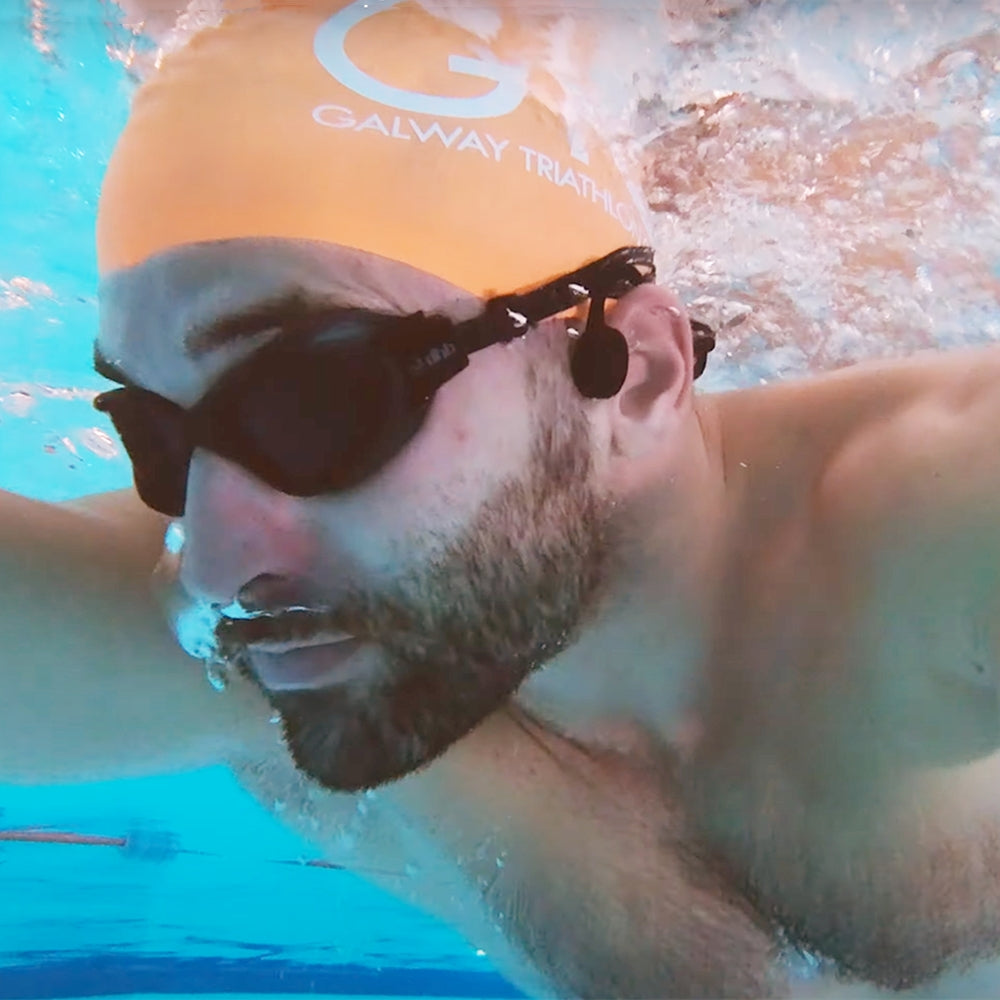
The NANK Runner 4 bone conduction headphones deliver premium sound while keeping your ears open to ambient sounds, ensuring safety during outdoor activities like running and cycling. Unlike traditional headphones that rely on eardrum vibrations, bone conduction technology delivers sound directly through your skull.
Core Features:
• IP68 3rd Gen Waterproof: It can be immersed in fresh water at a depth of 1.5-3m for 0.5-1 hour, and copes with daily waterproofing such as rain.
• Lightweight: Weighs only 26g, provides a comfort experience.
• Premium Sound Quality: NANK 3th ResoVibe™ Technology and OT leakage reduction 3.0, which effectively minimizes the amount of sound that escapes from the headphones.
• Bluetooth 5.4 + 16 GB MP3 Player: Bluetooth mode plus TF mode, so you can get rid of Bluetooth and mobile phones and enjoy music in MP3 mode.
• 8 Hours Play Time: Quick Charge for up to 2.5 hours.
• Easy Control: A useful physical button to control play, pause, answer calls, and end calls with one hand.
• Born For Sports: With skin-friendly silicone and ergonomic design, it is not easy to slip, perfect for trail run, park run and bicycle activities.
✅ Pros: IP68 at 26 g with magnetic charging passes the four-point test in full; a titanium frame that follows around the back of the head under constant, light tension; onboard storage at a price where most rivals still charge extra.
❌ Cons: The sound quality of bone conduction headphones is not as good as that of earbud headphones due to the different ways in which sound is transmitted and produced. Bluetooth will not travel through water, so switch to MP3 mode before you submerge.
Price: Sale price $79.99, Regular price $99.99.
Best For: Road and trail runners who want one pair that survives 90 minutes in the rain and still handles park runs and bicycle activities.
Conclusion
Sealed buds win on deep bass output. Physics will not negotiate that fact. Any active runner should choose open designs, keeping total awareness alongside all day comfort. Visit NANK to explore premium audio securely and upgrade your daily listening sessions right now.
Are bone conduction headphones loud enough for busy roads?
Yes, comfortably, alongside normal traffic. Volume sits lower than sealed buds by design, so podcasts typically need around 70% output where music needs closer to 55%.
Do open ear headphones leak sound to people nearby?
Slightly, above 70% volume in quiet spaces. Outdoors nobody notices. Gym treadmills at conversational distance are the only setting where anyone glances over.
Is a single earbud for running safer than a pair?
Marginally, and it is a poor compromise. One-sided listening skews your sense of direction, the exact skill you were trying to protect.
